
Winter strips a wood back to its bones, and for a beginner that can feel like the worst time to learn trees. The leaves are gone, the canopy is a scribble of grey, and every trunk starts to look the same. Here is the good news: oaks are among the easiest trees to identify without a single leaf. Once you know what to look for on the twigs and trunk, you can pick out an oak from twenty paces — and with a little more practice, tell our two native species apart.
Why winter is a good time to look at oaks
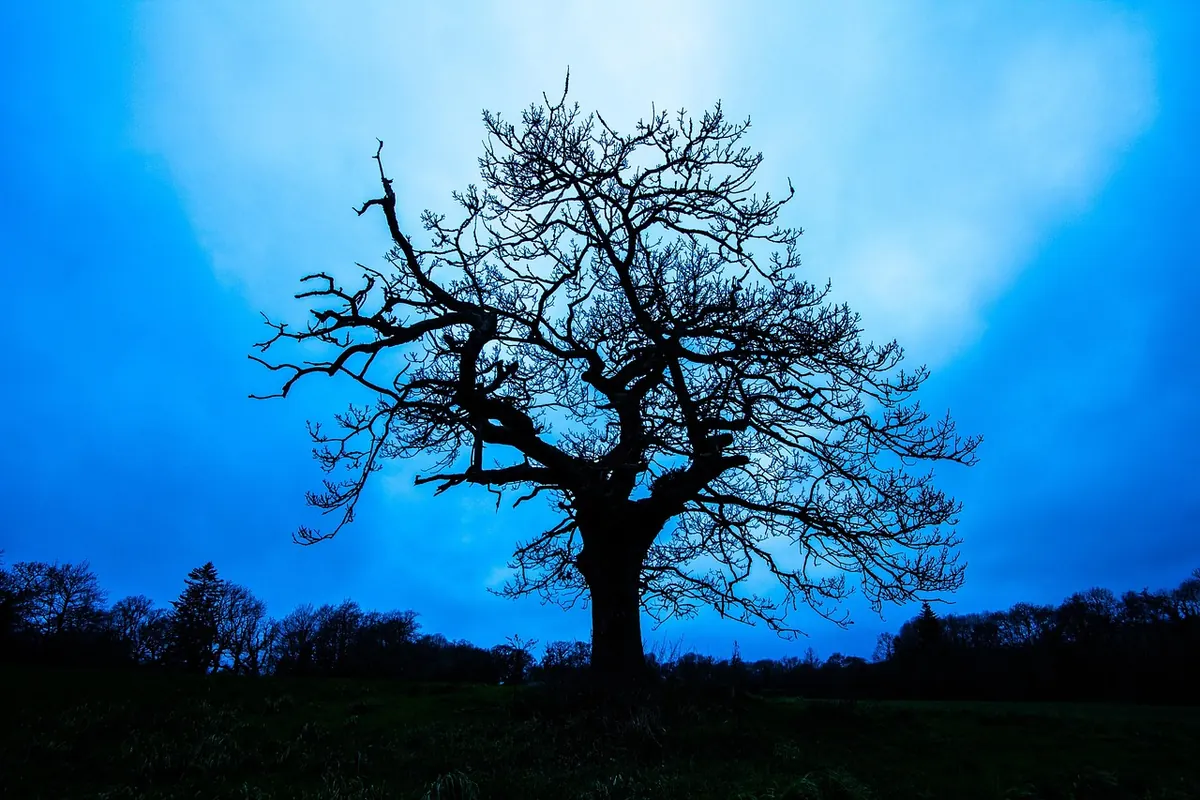
In summer, oaks hide in plain sight among ash, sycamore and beech. In winter, their architecture stands out. Oaks have a distinctive habit: thick, sinuous limbs that twist and turn rather than shoot straight up, often with a kink or two where old branches have died back. Mature trees look heavy and broad-shouldered, and many hold onto a few dead stubs in the crown.
There is also an advantage to the bare months. Buds, bark and twig structure are stable features. A leaf is here today and on the ground by October, but a bud sits in the same place on the same twig all winter. Learn it once and it will be waiting for you next December.
Meet the two native oaks
Britain has two widespread native oaks, and they are close enough relatives that they happily hybridise where they grow side by side. That means some trees will not fit neatly into either box, and that is normal. Do not let it put you off; most trees in most woods will give you a clear answer.
- English oak (Quercus robur), also called pedunculate oak — the classic lowland oak of hedgerows, parkland and heavy clay soils.
- Sessile oak (Quercus petraea) — the oak of upland Britain, western woods, sandstone and thin acid soils.
The names give the game away once you know the Latin. Pedunculate refers to the long stalk that carries the acorn; sessile means sitting directly on the twig. In winter you rarely have acorns to hand, so you need the other clues.
Start with the twigs
Pick a low branch or a fallen twig and look closely. Oak twigs are grey-brown and slightly zig-zagged rather than ruler-straight, with buds arranged alternately along the stem. The buds themselves are clustered towards the tip, and they are rounded rather than pointed — a useful contrast with beech, whose long, sharp buds look like little cigars.
The single most reliable winter difference between the two oaks is the buds.
English oak buds
Plump, rounded and blunt, often described as egg-shaped. They tend to sit slightly away from the twig on short stalks, and the buds near the tip of a shoot are usually clearly clustered. The scales are reddish-brown and the whole bud has a soft, rounded look.
Sessile oak buds
Longer, more tapered and pointed, pressed closer to the twig. They are often a shade darker, and the terminal bud at the very tip of the shoot is usually well formed and prominent. If a bud looks as though it has been drawn out to a point rather than left as a blunt knob, you are probably looking at sessile oak.
The five-pointed pith trick
Here is a detail that feels like a secret the first time you use it. Snap a thin oak twig cleanly and look at the soft centre, the pith. On English oak it typically forms a five-pointed star shape. On sessile oak it is more rounded or wavy-edged and lacks those clean points.
A word of caution: this varies, and some twigs are too young or too old to show it clearly. Treat the pith as a supporting clue rather than proof, and always use a twig you have already found on the ground. There is no need to damage a living tree to learn it.
Reading the bark
Bark is the least trustworthy winter clue on its own, because age, soil and growing conditions all change it. Even so, it points you in the right direction.
English oak tends to develop deep, rugged fissures and thick ridges, giving older trunks a heavy, corrugated look. Sessile oak bark is usually smoother for longer, with shallower cracks and sometimes a greyish, almost plated appearance. In a wet western wood, a big oak with bark like a dried riverbed is more likely to be English oak; a tidier, smoother trunk on a slope is often sessile.
Ignore the moss, algae and lichen. They tell you about the tree's microclimate, not its species.
Fallen acorns and the ground beneath
Even in winter, acorns survive in the leaf litter, and they are the quickest confirmation you will get.
- Find an acorn and look at where it meets the cup.
- If there is a clear stalk between the cup and the twig it grew on, that is English oak.
- If the cup sits almost flush against the twig, with no stalk, that is sessile oak.
- Check the cup scales too: English oak cups have scales that sit flat and neat, while sessile oak scales are often more raised and knobbly.
Work backwards from the acorn if you can. A single acorn under a tree is better evidence than an hour of squinting at bark.
Putting it together on a winter walk
No single feature is perfect, so build a case rather than chasing a verdict. Choose a tree, then work through the clues in order of reliability: acorns first if any are present, then buds, then twigs and pith, and finally bark and habitat as supporting evidence. Three clues pointing the same way is a solid identification; five is a certainty.
Keep a small notebook or a phone note of what you see. Record the date, the place and two or three features, and after a dozen trees you will start recognising oaks before you have consciously checked anything — the same way you recognise a face before you name it. Winter identification rewards patience rather than cleverness.
If you want a second opinion, a good illustrated field guide to trees is worth keeping in your coat pocket, and local wildlife trusts and woodland groups often run winter tree identification walks where you can check your guesses against someone who knows the wood well. Take a hand lens if you have one, wear boots you do not mind getting muddy, and remember that the tree in front of you does not care whether you get it right. That is the whole pleasure of learning.
Photo: diego_torres / Pixabay